
The Best Dry Eye Drops Without Preservatives — and Why Avoiding Harmful Chemicals Matters
Dry eye is one of the most common eye complaints — and also one of the most mismanaged. Millions of people reach for the nearest bottle of artificial tears every morning without a second thought. But the drops you’ve been trusting to soothe your eyes may contain ingredients that are quietly making things worse.
The good news: a growing number of preservative-free options give your eyes genuine relief without the chemical baggage. Knowing what to look for — and what to avoid — can make a real difference in how your eyes feel day to day.
What’s in Your Eye Drops? (Most People Never Check)
Read the label on most multi-dose artificial tears and you’ll find a preservative — usually benzalkonium chloride, or BAK. It’s there for a practical reason: once you open a bottle and expose it to air, bacteria can contaminate it. BAK is effective at preventing that.
The problem is what it does to your eyes in the process.
BAK is a surfactant — it works by disrupting cell membranes. That’s how it kills bacteria. But your cornea and conjunctiva are lined with delicate epithelial cells, and those cells don’t appreciate being exposed to a membrane-disrupting chemical multiple times a day, every day.
Beyond BAK, a less-discussed concern is PFAS — per- and polyfluoroalkyl substances, commonly known as “forever chemicals.” Independent testing organizations have flagged PFAS in some contact lens solutions and certain personal care product packaging materials. If you already check your cookware and food containers for PFAS, it’s worth applying that same scrutiny to your eye care routine.
Why Benzalkonium Chloride (BAK) Is the Biggest Red Flag
Research in ophthalmology has accumulated over decades on the effects of chronic BAK exposure. The picture isn’t flattering.
BAK damages goblet cells — the cells in your conjunctiva that produce the mucin layer of your tear film. Mucin is what makes your tears stick to the surface of your eye rather than sliding off. Lose goblet cells, and your tear film becomes unstable, evaporating faster and leaving dry patches. You use more drops. The drops contain more BAK. The cycle continues.
Studies have also shown that chronic BAK exposure causes:
- Inflammation of the ocular surface
- Corneal epithelial cell death (apoptosis)
- Disruption of the tear film lipid layer
- Delayed recovery of the surface after injury
For people using drops several times a day — which is most people with chronic dry eye — this is a real concern. Glaucoma patients face compounded risk, since many prescription glaucoma eye drops also contain BAK. Using multiple preserved drops daily stacks the exposure.
Some countries have moved to restrict BAK concentrations in ophthalmic products specifically because of this research. The U.S. hasn’t imposed the same limits yet, but the science is clear enough that many ophthalmologists now recommend preservative-free options as the default for daily users.
The PFAS Problem in Eye Care Products
You’ve probably heard about PFAS in non-stick cookware, waterproof clothing, and food packaging. But eye care products? It seems unlikely — until you look at the data.
PFAS are a family of thousands of synthetic chemicals. They’re valued in manufacturing because they repel water and oil and don’t break down. That’s also the problem: they accumulate in the body and the environment over time. Studies link PFAS exposure to thyroid disruption, immune system effects, and reproductive harm at very low concentrations.
Several independent studies and investigative reports have identified PFAS in contact lens solutions and, in some cases, the packaging materials of certain personal care products, including bottles with fluoropolymer-coated components. Not every product has been tested, and findings vary by brand and formulation. This doesn’t mean every bottle is contaminated, but it does mean informed consumers should ask questions.
The FDA has been increasing its scrutiny of PFAS in personal care products, and some manufacturers have started offering explicit PFAS-free certifications in response to consumer demand. If PFAS avoidance matters to you, contact the manufacturer of your current drops and ask directly. If they can’t answer, that’s an answer of its own.
What “Preservative-Free” Really Means on a Label
This is where it gets nuanced, because “preservative-free” isn’t always as simple as it sounds.
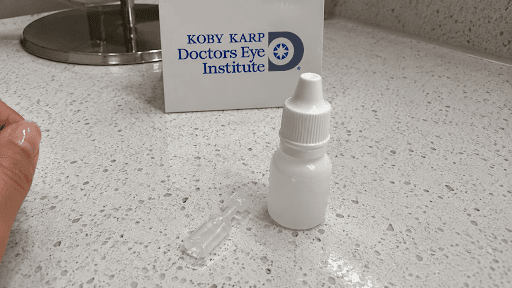
True preservative-free drops come in single-use vials. Each tiny vial contains one application (or one dose per eye). Because the vial is opened, used, and discarded, no preservative is needed — there’s nothing to contaminate. These are the safest option for people with sensitive eyes, heavy users, and contact lens wearers.
Multi-dose preservative-free systems use clever engineering to keep the bottle contamination-free without chemicals. The COMOD system, for example, uses an airless pump that prevents outside air from entering. No air means no bacterial contamination, so no preservative is needed. These reduce single-use plastic waste and are a good option for people who find single vials inconvenient.
A third category uses “vanishing” preservatives — compounds like sodium perborate or OxyChloro Complex (Purite) that break down on contact with light or tears. These are meaningfully safer than BAK for most people, and some sensitive eyes tolerate them well. But they’re not technically preservative-free; the breakdown products are generally inert but aren’t zero.
When shopping, look for the abbreviation “PF” on the label — it stands for preservative-free. Products in unit-dose vials will almost always be preservative-free; multi-dose bottles require more careful reading.
The Best Dry Eye Drops Without Preservatives — What to Look For
Rather than ranking brands (formulations change, and what matters is what’s in the drop), here’s what to look for in a quality preservative-free artificial tear:
Sodium hyaluronate (hyaluronic acid): A natural component of the vitreous humor in your eye. Sodium hyaluronate binds water and provides long-lasting lubrication. Drops with 0.1–0.3% sodium hyaluronate tend to last longer on the eye surface.
Glycerin: A humectant — it draws water into the tissues and holds it there. Great for evaporative dry eye, which is the most common type (caused by a weak lipid layer in the tear film).
Carboxymethylcellulose (CMC): A cellulose-based polymer that mimics the mucin layer of natural tears. It coats the eye surface and improves tear film stability. Very well tolerated.
Trehalose: A naturally occurring sugar that stabilizes cell membranes under stress. Trehalose-containing drops have shown benefit specifically for patients with more severe ocular surface disease.
What to avoid: Drops with BAK, benzododecinium bromide, or other quaternary ammonium compounds listed in the inactive ingredients. Also be cautious with drops that list only “water” or saline with no active lubricant — these provide minimal relief.
Format: Single-use vials are the gold standard for safety. COMOD or airless-pump multi-dose bottles are a strong second choice. For a deeper look at specific options, see our guide to the best eye drops to help your dry eyes.
Who Should Prioritize Preservative-Free Drops?
Switching to preservative-free drops is a good idea for almost everyone who uses artificial tears regularly, but it’s especially important for these groups:
Heavy users: If you’re applying drops four or more times daily, you’re accumulating significant BAK exposure with standard preserved drops. Preservative-free is the right call.
Contact lens wearers: BAK can bind to soft contact lens material and concentrate against the eye, increasing surface exposure beyond what the drop label suggests. Most preservative-free drops are contact-lens compatible.
Post-LASIK patients: The corneal nerves that regulate tear production are temporarily disrupted after laser surgery. The ocular surface is more vulnerable during this period. Preservative-free drops are standard recommendation after any refractive procedure.
People with blepharitis: Blepharitis causes chronic lid margin inflammation that destabilizes the tear film. Adding BAK to already-inflamed eyes can worsen symptoms.
Glaucoma patients: Many glaucoma medications already contain BAK. Adding preserved artificial tears on top creates compounded exposure that can accelerate ocular surface damage.
Anyone with sensitive eyes or existing surface disease: If your eyes have reacted to drops before, or if you have conditions like rosacea, allergies, or Sjögren’s syndrome, preservative-free is safer.
When Drops Aren’t Enough — Time to See a Dry Eye Specialist
The best preservative-free drops on the market can relieve symptoms. What they can’t do is fix the underlying problem.
If you’ve been using drops consistently for two to three months without meaningful improvement — or if your symptoms are interfering with screen work, driving, or reading — the drops aren’t the answer. Understanding what causes dry eye syndrome in the first place is often the missing piece. Your eyes may be telling you something deeper is going on: meibomian gland dysfunction (the blocked oil glands that account for the majority of dry eye cases), chronically low tear production, blepharitis, or another condition that needs diagnosis, not just lubrication.
A dry eye specialist can evaluate the health of your meibomian glands, measure your tear volume and stability, check your tear film osmolarity, and identify exactly what type of dry eye you have. That matters, because meibomian gland dysfunction responds to different treatments than aqueous-deficient dry eye. Learn more about what advanced dry eye treatment looks like in practice.
Still reaching for drops every hour?
The team at KOBY KARP DOCTORS EYE INSTITUTE evaluates the root cause of dry eye
so you can get real relief, not just temporary comfort.
Frequently Asked Questions
Are preservative-free drops more expensive than regular drops?
Yes, typically — single-use vials cost more per unit than a multi-dose bottle. The cost gap has narrowed as demand has grown. For anyone using drops multiple times daily, the eye health benefit more than justifies the price difference.
Can I use preservative-free drops while wearing contact lenses?
Most are safe — but check the label. Products labeled “contact lens compatible” or “for use with contact lenses” are your safest option. Preserved drops can bind to lens material and concentrate the preservative against your cornea.
What’s the difference between single-dose vials and multi-dose preservative-free systems?
Single-dose vials contain no preservative at all — the sealed, single-use design prevents contamination. Multi-dose preservative-free systems (like COMOD) use an airless pump that prevents bacterial entry, eliminating the need for a preservative. Both are valid choices. The COMOD-style bottle reduces single-use plastic waste.
Are PFAS found in all eye drops?
Not in all — and not all products have been independently tested. PFAS concerns in eye care relate mainly to packaging materials (fluoropolymer-coated caps and components) and certain inactive ingredients. This is an evolving area. If concerned, look for brands with explicit PFAS-free certifications, or contact the manufacturer and ask directly.
How do I know if I need prescription dry eye treatment instead of OTC drops?
Two to three months of consistent, quality preservative-free drop use without real improvement is a clear signal. So are symptoms that interfere with daily activities — reading, screen use, driving at night, wearing contacts. Prescription options like Restasis or Xiidra target inflammation rather than just adding lubrication. In-office treatments can restore meibomian gland function. An ophthalmologist can tell you which path makes sense for your situation.