
Laser Vitreolysis vs Vitrectomy: Comparing non-surgical floater treatments
You are driving down the highway, and suddenly, a dark shadow darts across your line of sight. You swat at it, thinking it is a bug, but nothing is there. Or perhaps you are trying to read a book, and a cluster of grayish cobwebs drifts across the page, forcing you to blink repeatedly just to clear your focus.
If this sounds familiar, you know exactly how disruptive eye floaters can be to your daily life.
The Frustration of Eye Floaters (And Why You Don’t Have to “Just Live With Them”)
For many adults over the age of 60, eye floaters are a daily, persistent annoyance. They show up as dots, strings, or thick shadows that drift when you move your eyes.
These visual interruptions are typically caused by a natural aging process called posterior vitreous detachment (PVD). Inside your eye is a jelly-like substance known as the vitreous. As you age, this gel begins to shrink and pull away from the back of the eye. When it does, the collagen fibers inside the gel clump together. These clumps cast shadows on your retina, which you perceive as floaters.
The most frustrating part of dealing with floaters isn’t just the visual blockages—it is the response from the medical community. General optometrists will often perform an exam, see that your retina is healthy, and tell you to “just live with it.” They treat floaters as a harmless nuisance. But when you can no longer read a screen comfortably, drive safely at night, or enjoy a clear blue sky, it doesn’t feel harmless. It feels like a severe drop in your quality of life.
Tired of cobwebs and dark spots making it hard to read, drive, or work on your computer?
We provide a quick, in-office procedure that safely clears your vision without the need for needles or an operating room.
Clarifying the Options: Non-Surgical vs. Surgical Treatments
When patients finally decide they cannot simply ignore their floaters anymore, they start looking for answers online. Often, they search for information on “comparing non-surgical floater treatments” and find confusing, mixed results.
It is very common for patients to mix up these options. Sometimes, people read about a procedure called a Vitrectomy and assume it is a minor, non-surgical fix. Make no mistake: a Vitrectomy is a highly invasive surgery.
If you are looking for a true, non-surgical, out-patient alternative, you are looking for Laser Vitreolysis. Modern eye care allows us to use this advanced laser therapy as the primary defense against floaters, leaving invasive surgeries as an absolute last resort.
What is Laser Vitreolysis? (The Non-Invasive Solution)
Laser Vitreolysis is an in-office, pain-free procedure that eliminates floaters without incisions, needles, or an operating room.
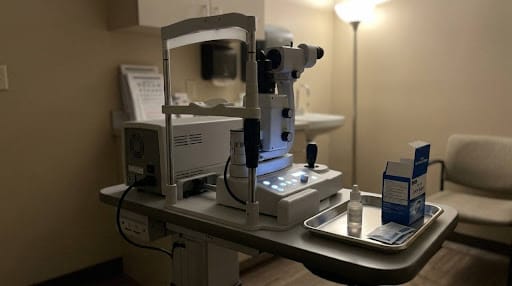
When you sit in the treatment chair, the doctor will apply mild numbing drops to your eyes and place a special contact lens on your eye to keep it open and focused. The doctor then uses a highly precise YAG laser to target the exact floaters clouding your vision.
Here is the best part: the laser doesn’t just break the floater into smaller, more annoying pieces. The energy from the YAG laser actually vaporizes the collagen and hyaluronic acid clumps, turning them into a harmless gas. This gas is then naturally absorbed by your eye.
The benefits of Laser Vitreolysis include:
- Zero Incisions: No needles or cutting are involved.
- Comfortable: We use topical anesthesia and a contact lens to keep the eye still. Most patients report feeling only mild pressure rather than pain.
- Low Downtime: This is an in-office treatment offering a low-downtime middle ground. Vision usually clears within 24 hours, and you can leave with no lifting restrictions.
What is a Vitrectomy? (The Surgical Route)
A Vitrectomy is the traditional, surgical method for removing floaters. While it is highly effective at clearing the eye, it is an aggressive approach reserved for the most extreme, vision-threatening cases.
During a Vitrectomy, you are taken into an operating room. A surgeon makes microscopic incisions in your eye and uses a suction tool to physically remove the entire vitreous gel—along with the floaters inside it. Once the gel is removed, the surgeon pumps a specialized saline solution into the eye to replace the lost volume and keep the eye’s shape.
Because it is a true surgery, it comes with a much higher risk profile:
- Accelerated Cataracts: A Vitrectomy carries significant risks, including cataract acceleration in phakic eyes.
- Retinal Detachment: The process of pulling the gel out of the eye carries a risk of tearing the retina, which can lead to permanent vision loss.
- Longer Recovery: You will face a longer healing period and potential physical restrictions while your eye adjusts to the saline replacement.
Vitreolysis vs. Vitrectomy: Which is Right for You?
Deciding how to manage your vision requires a clear look at the facts. Here is a direct comparison to help you understand the differences:
Feature | Laser Vitreolysis (YAG Laser) | Vitrectomy (Surgery) |
Invasiveness | Non-invasive (No incisions) | Highly invasive (Incisions & fluid removal) |
Location | Doctor’s Office | Hospital or Surgery Center |
Recovery Time | Immediate / Same Day | Weeks of healing and restrictions |
Pain Level | Mild pressure (Topical anesthesia used) | Post-operative discomfort |
Risk Profile | Low (Minimal risk to surrounding tissue) | High (Cataracts, retinal detachment risks) |
The only way to know for sure which path is right for you is to undergo a thorough dilated eye exam. While Laser Vitreolysis is incredibly safe, not all floaters can be treated with it. If your floaters are positioned too close to your retina or your natural lens, the laser cannot be safely used, and other options must be considered.
Take Back Your Vision with Koby Karp Doctors Eye Institute
You do not have to accept failing vision, and you certainly do not have to rush into a hospital operating room to fix it.
At Koby Karp Doctors Eye Institute, we are the local authorities on safe, effective YAG laser treatments. We believe in providing solutions that get you back to reading, driving, and enjoying life without the anxiety of heavy surgical risks.
FAQ
Does Laser Vitreolysis hurt?
No. Before the procedure begins, we use anesthetic eye drops to completely numb the surface of your eye. During the treatment, you will only see small flashes of light and hear a soft clicking sound from the machine. There is no pain during the session, and you will not experience any pain afterward.
How many laser sessions will I need to get rid of my floaters?
While some patients achieve crystal-clear vision after just one session, we want to set realistic expectations. Certain types of floaters can be stubborn. They typically require 1 to 3 treatments, spaced four weeks apart, to completely vaporize the clumps.
Will my insurance cover laser floater removal?
Because every patient’s situation is unique, costs can vary. During your visit, we will outline personalized estimates and discuss all pricing details before you commit to any treatment.
Can floaters come back after laser treatment?
The specific floaters that the YAG laser vaporizes are gone forever; they will not return. However, because your eyes will continue to age, the remaining vitreous gel can still shrink and form brand-new clumps over time. If new floaters develop years down the road, you can simply return for another brief laser session.
Ready to stop swatting at invisible shadows
and get your clear vision back?
Call our clinic today. Our specialists will perform a dilated exam to map your floaters and build a treatment plan customized directly for your eyes.